"A machine you cannot yet buy can still be programmed."
Quantum computers are rare, costly and still far from steady. The work of deciding what to ask one does not have to wait for that.
VERQIS writes quantum algorithms, rehearses them on ordinary hardware, and checks the answers for the errors this kind of computing carries. The toolchain for all three is held in house today.

The machines that run quantum programs sit in a handful of laboratories. Access is rationed, queued and priced accordingly, and the hardware itself changes shape from one generation to the next.
Choosing what to ask a quantum computer, expressing it as a circuit, and knowing how large a machine the question needs — none of that requires owning one. It is ordinary software work, done on ordinary computers.
A question already written, already rehearsed and already costed can move onto real hardware the week it becomes available. A question not yet written cannot.
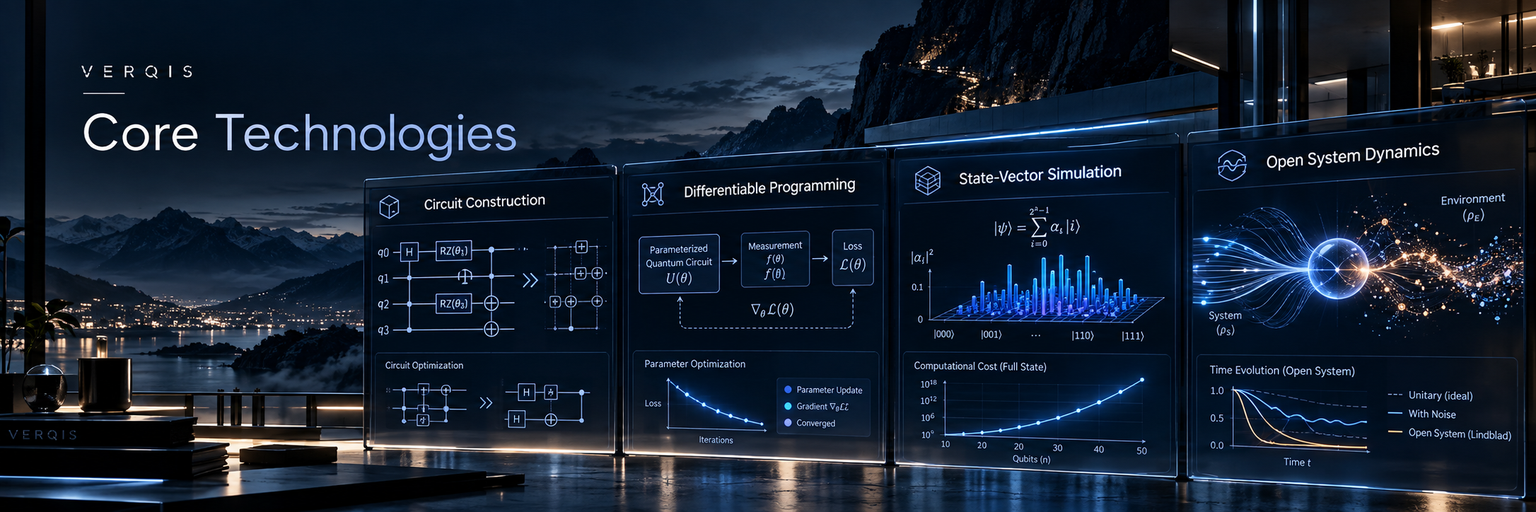
Quantum work is expressed as a circuit: a sequence of operations applied to a register. The tools we work with let gates be defined by hand, parameters be carried as symbols, and whole circuits be rewritten and tightened before they run.
A parameterised circuit can be joined to a machine-learning framework and trained the way a network is trained, with gradients flowing through the quantum part rather than around it.
A full state-vector simulator carries every amplitude of the register at once. It is exact, and its cost climbs steeply with each qubit added — which is precisely why the size of a question matters.
Real devices are never isolated. Modelling how a quantum system evolves while it leaks into its surroundings, with time-dependent terms, is a separate discipline from circuit work and needs its own tooling.
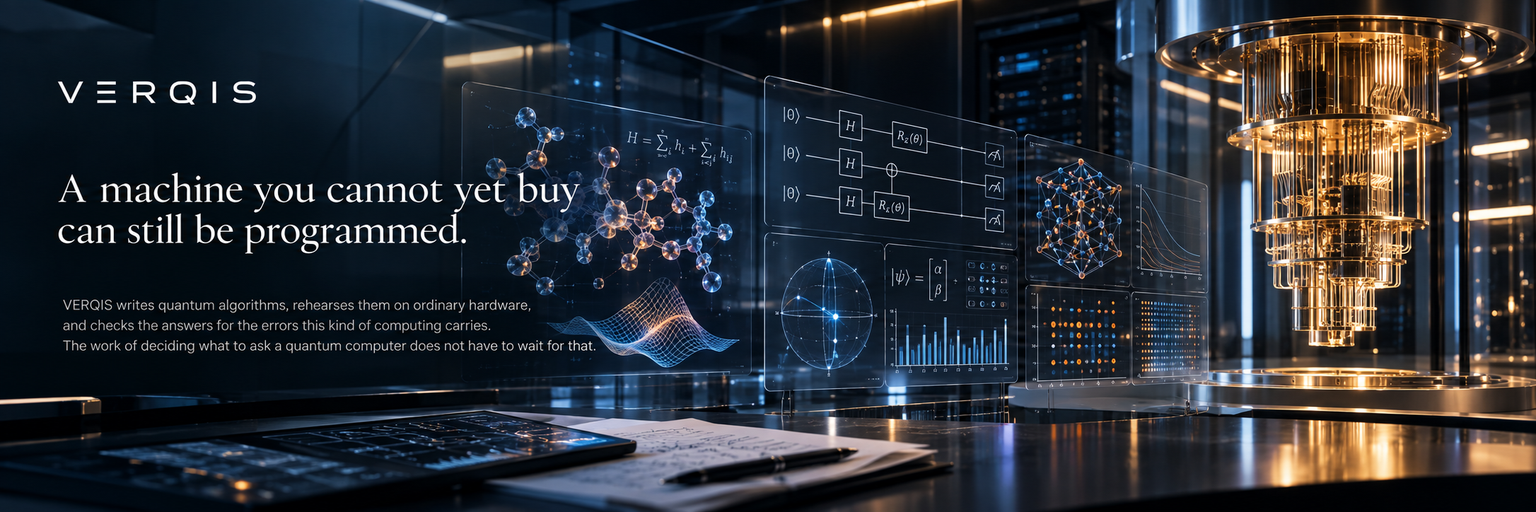
The lowest energy state of a molecule tells you how stable it is. Hybrid quantum algorithms search for that state, which is the calculation behind candidate screening for medicines, catalysts and battery materials.
Routing, scheduling and allocation problems grow faster than they can be searched exhaustively. Quantum optimisation approaches aim at good answers to exactly this shape of problem.
Quantum answers drift. Given the detection record from a run, a decoder reconstructs the most likely set of errors behind it, so the true answer can be recovered from a noisy one.
Everything above can be run on ordinary computers first, with noise modelled in, so an algorithm is tested and corrected long before machine time is spent on it.
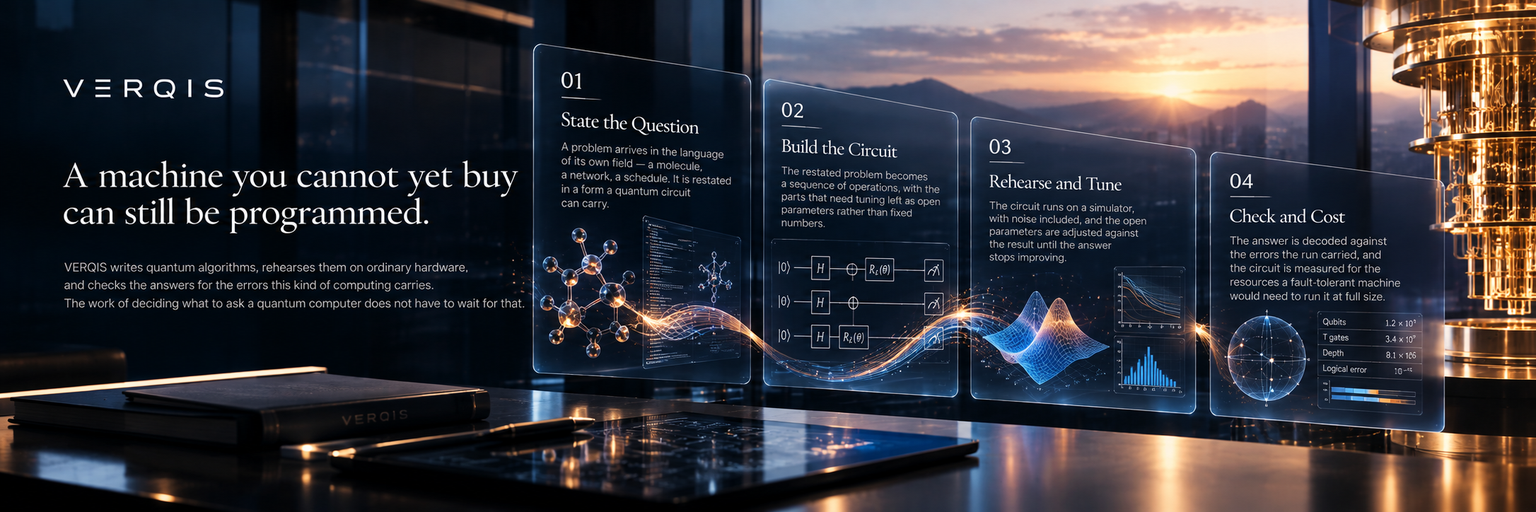
A problem arrives in the language of its own field — a molecule, a network, a schedule. It is restated in a form a quantum circuit can carry.
The restated problem becomes a sequence of operations, with the parts that need tuning left as open parameters rather than fixed numbers.
The circuit runs on a simulator, with noise included, and the open parameters are adjusted against the result until the answer stops improving.
The answer is decoded against the errors the run carried, and the circuit is measured for the resources a fault-tolerant machine would need to run it at full size.
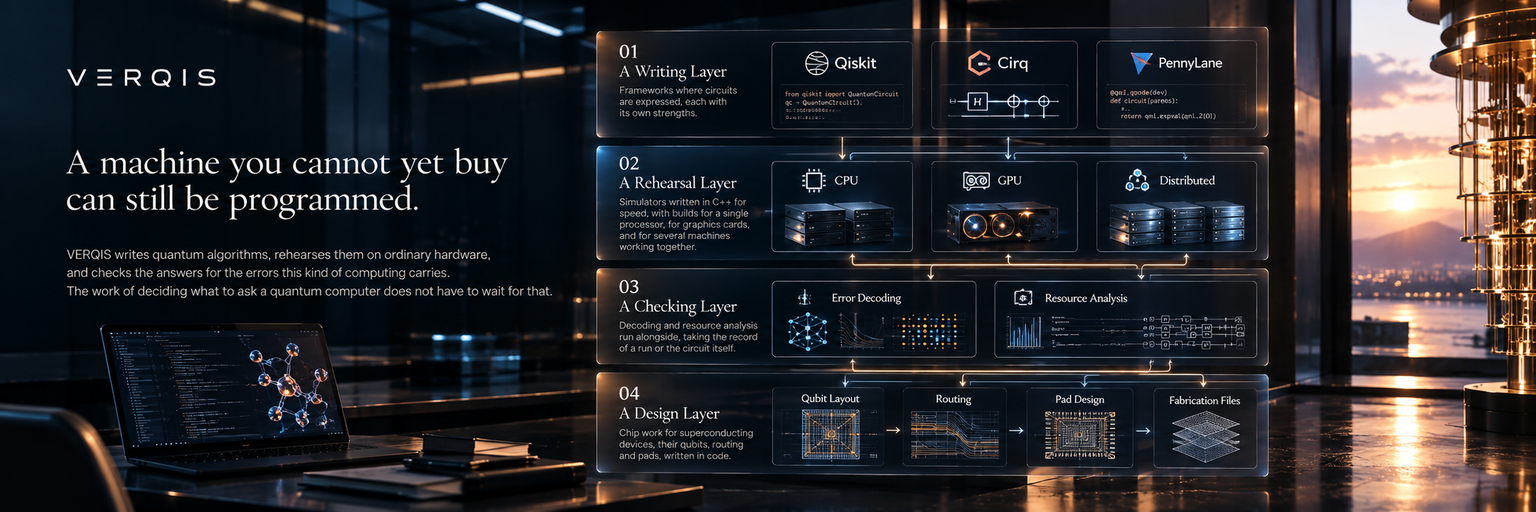
At the top sit the frameworks where circuits are expressed. They differ in temperament — one leans toward hardware detail, another toward machine learning — and a question is written in whichever suits it.
Beneath them sit the simulators, written in C++ for speed, with builds for a single processor, for graphics cards, and for several machines working together. The writing layer calls down into whichever is available.
Alongside sits the decoding work, which takes the record of a run rather than the circuit itself, and the resource analysis, which takes the circuit and reports what a full-scale machine would need.
Separate again is the chip work: laying out superconducting devices, their qubits, their routing and their pads, in code rather than by hand.
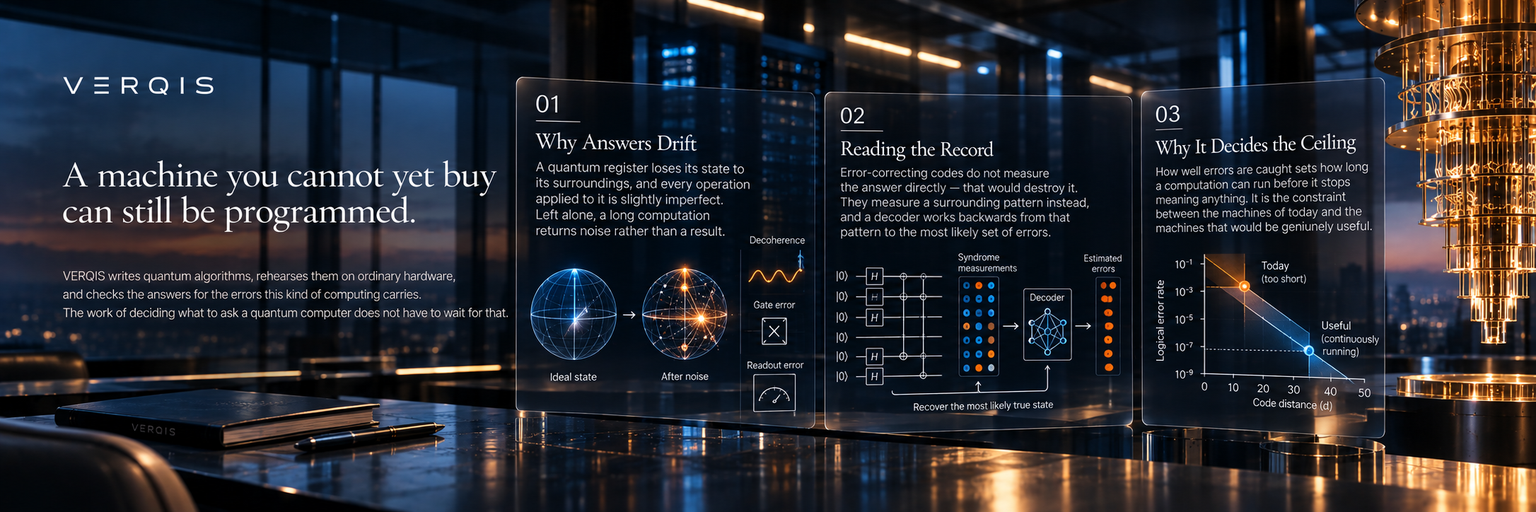
A quantum register loses its state to its surroundings, and every operation applied to it is slightly imperfect. Left alone, a long computation returns noise rather than a result.
Error-correcting codes do not measure the answer directly — that would destroy it. They measure a surrounding pattern instead, and a decoder works backwards from that pattern to the most likely set of errors.
How well errors are caught sets how long a computation can run before it stops meaning anything. It is the constraint between the machines of today and the machines that would be genuinely useful.
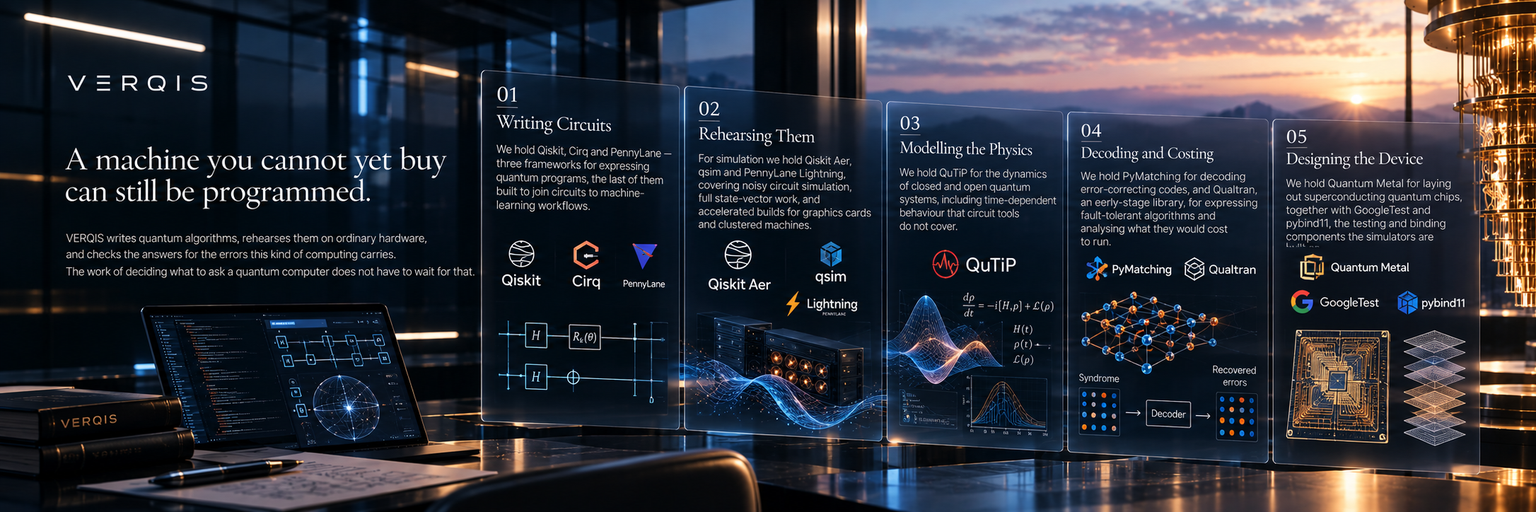
We hold Qiskit, Cirq and PennyLane — three frameworks for expressing quantum programs, the last of them built to join circuits to machine-learning workflows.
For simulation we hold Qiskit Aer, qsim and PennyLane Lightning, covering noisy circuit simulation, full state-vector work, and accelerated builds for graphics cards and clustered machines.
We hold QuTiP for the dynamics of closed and open quantum systems, including time-dependent behaviour that circuit tools do not cover.
We hold PyMatching for decoding error-correcting codes, and Qualtran, an early-stage library, for expressing fault-tolerant algorithms and analysing what they would cost to run.
We hold Quantum Metal for laying out superconducting quantum chips, together with GoogleTest and pybind11, the testing and binding components the simulators are built on.
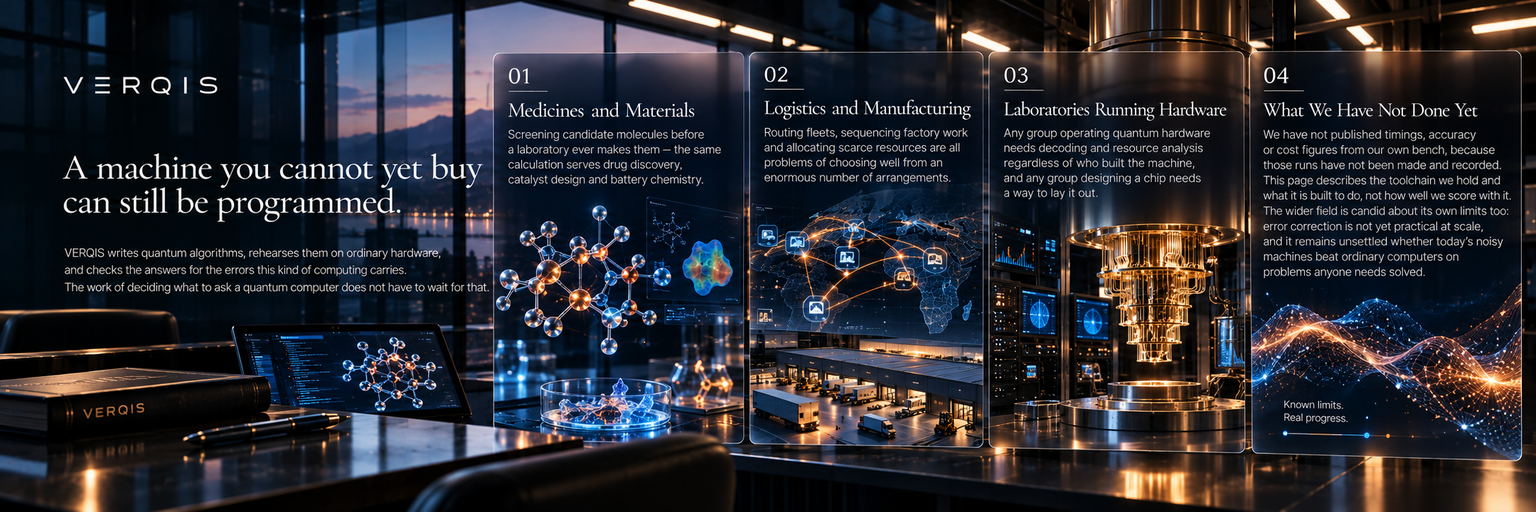
Screening candidate molecules before a laboratory ever makes them — the same calculation serves drug discovery, catalyst design and battery chemistry.
Routing fleets, sequencing factory work and allocating scarce resources are all problems of choosing well from an enormous number of arrangements.
Any group operating quantum hardware needs decoding and resource analysis regardless of who built the machine, and any group designing a chip needs a way to lay it out.
We have not published timings, accuracy or cost figures from our own bench, because those runs have not been made and recorded. This page describes the toolchain we hold and what it is built to do, not how well we score with it. The wider field is candid about its own limits too: error correction is not yet practical at scale, and it remains unsettled whether today's noisy machines beat ordinary computers on problems anyone needs solved.
"The hard part was never the machine. It was knowing what to ask it."
VERQIS — Quantum Algorithm Systems.