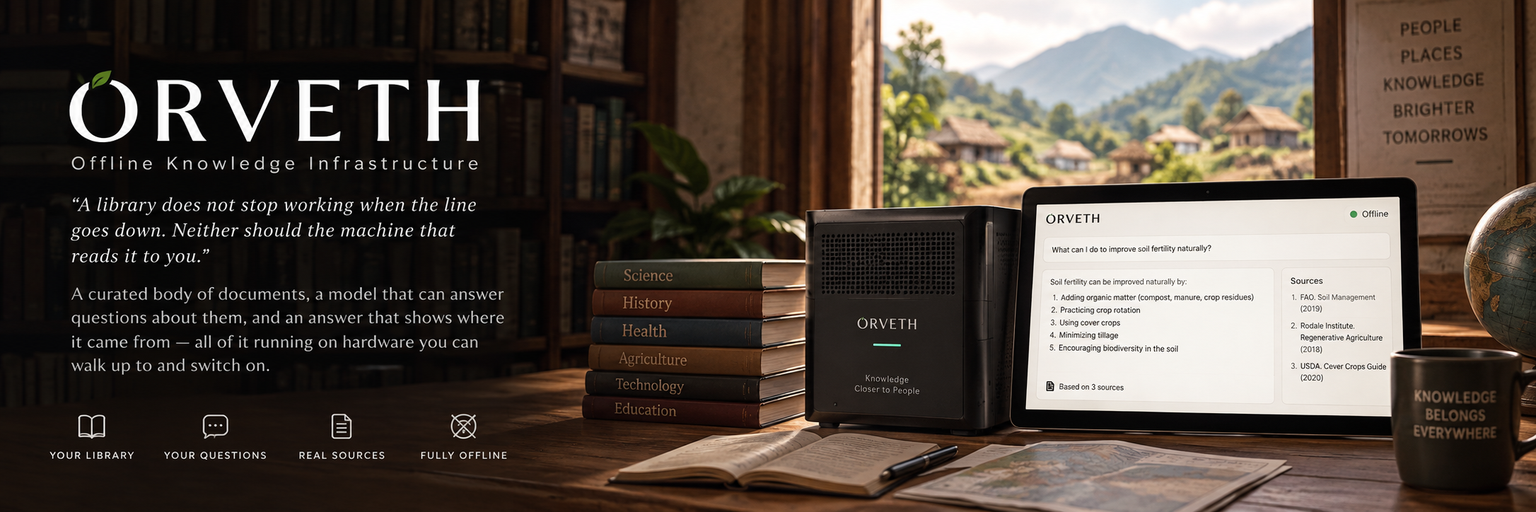
"A library does not stop working when the line goes down. Neither should the machine that reads it to you."
Most of what we call intelligence today lives somewhere else — behind a login, at the end of a link, in a building on another continent. Where that link is slow, expensive or simply absent, the knowledge might as well not exist.
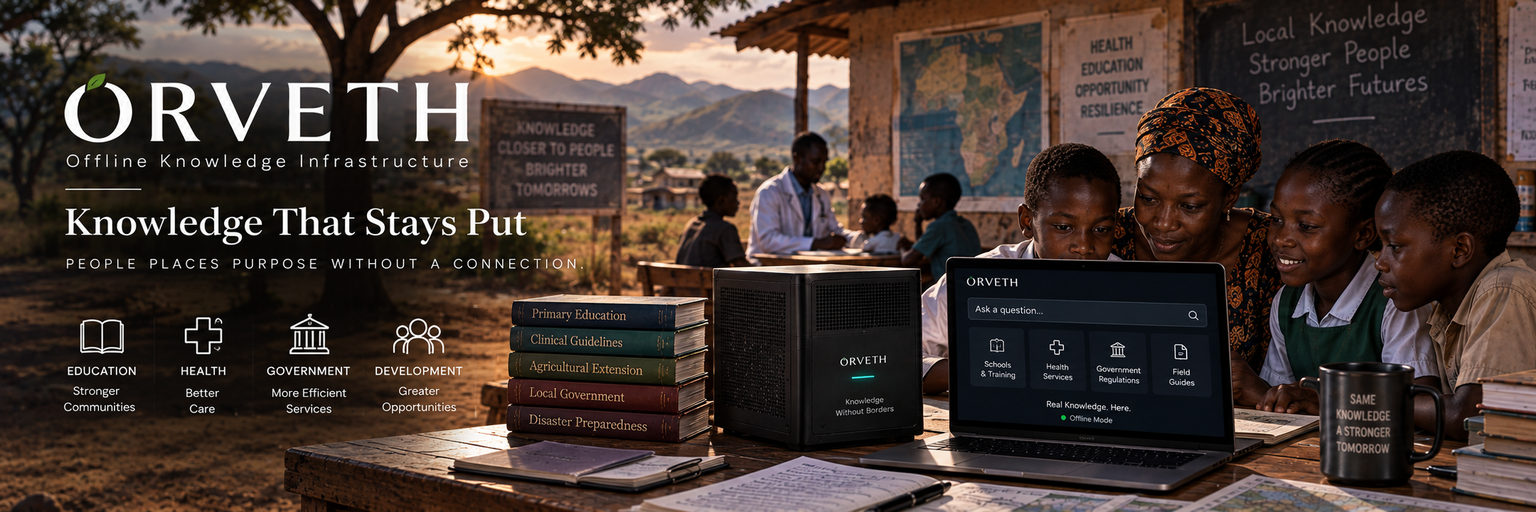
ORVETH puts the library and the reader in the same room. A curated body of documents, a model that can answer questions about them, and an answer that shows where it came from — all of it running on hardware you can walk up to and switch on.
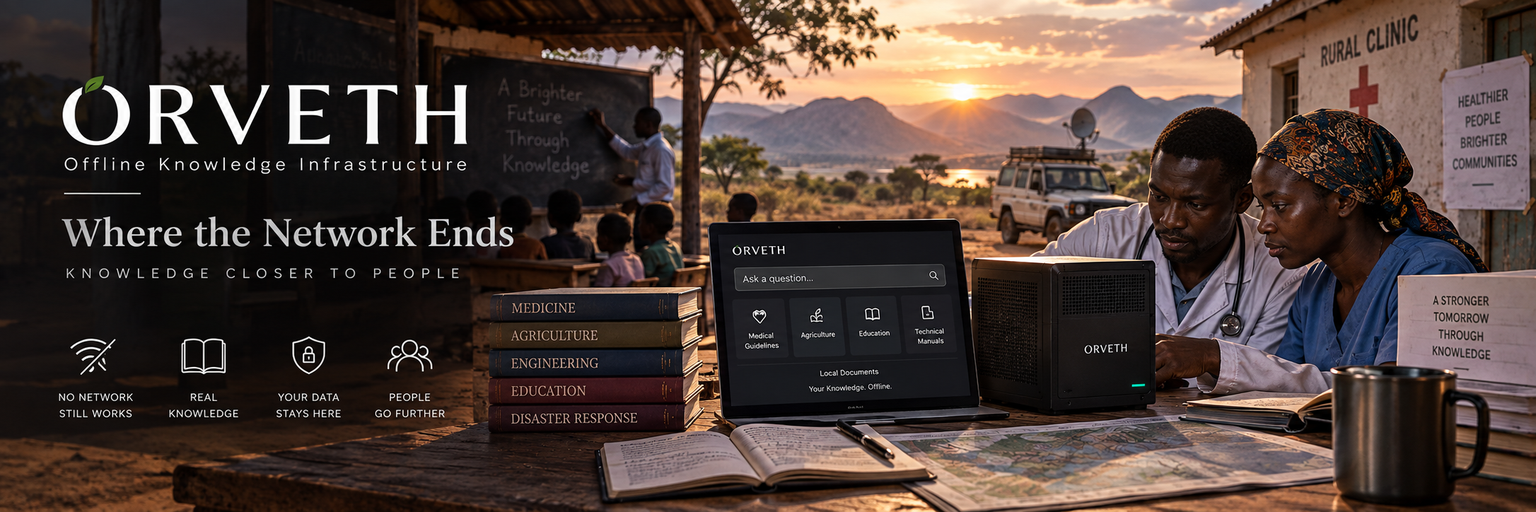
A rural clinic, a district school, a field station, a ship: the link drops for an afternoon or a fortnight, and every tool that assumed a connection stops being a tool.
Treatment guidelines, curricula, repair manuals, agricultural extension notes — most of it is published and free, and almost none of it is where the person who needs it is standing.
A hard drive of documents is not an answer. Someone still has to know which of ten thousand pages holds the paragraph that settles the question in front of them.
Patient files, case records, student data and internal procedures often cannot be sent to an outside service at all, whatever the connection is like. The system has to come to the data.
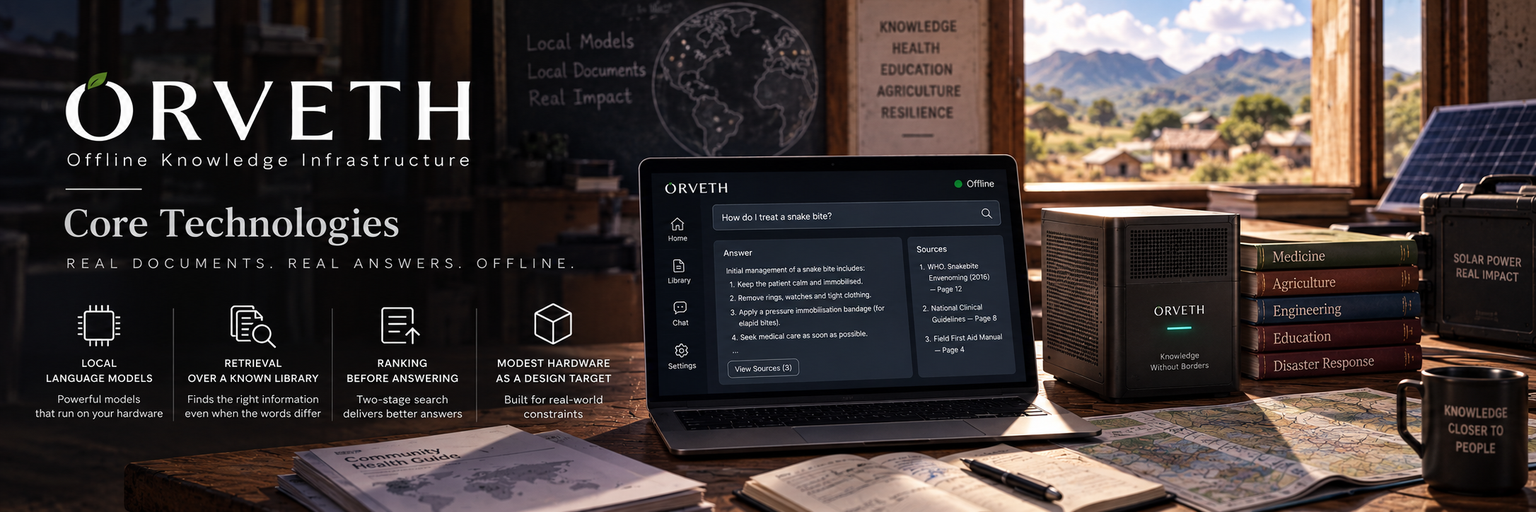
Open-weight models held on our own machines, quantised and tuned to the hardware in front of them, so the same question gets the same quality of answer whether or not anything is reachable beyond the room.
Documents are turned into searchable meaning rather than matched word by word, so a question phrased in ordinary language finds the passage that answers it even when the wording is nothing alike.
A first pass gathers candidate passages quickly and a second, slower pass re-reads them against the question, which keeps a plausible but irrelevant paragraph out of the answer.
The target is a single machine with one accelerator, a solar-backed supply and no assumption of a second one arriving soon — the constraint that decides which model, which quantisation and which index will actually be used.
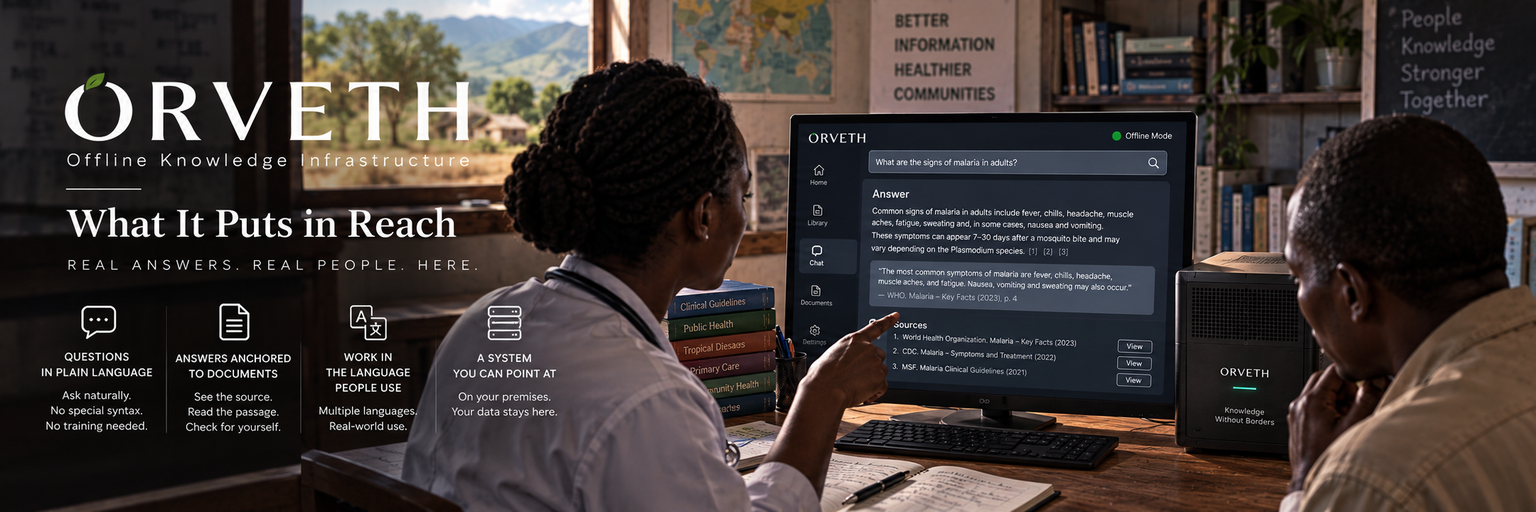
Staff ask the way they would ask a colleague — no query syntax, no folder structure to memorise, no training course before the first useful answer.
Every answer names the documents behind it and quotes the passage it relied on, so the reader can check the source rather than take the machine's word for it.
Retrieval and generation both handle the languages a collection is written in and the languages its readers ask in, which are frequently not the same language.
The library, the index and the model sit on a machine on the premises. Nothing about a question travels further than the room it was asked in.
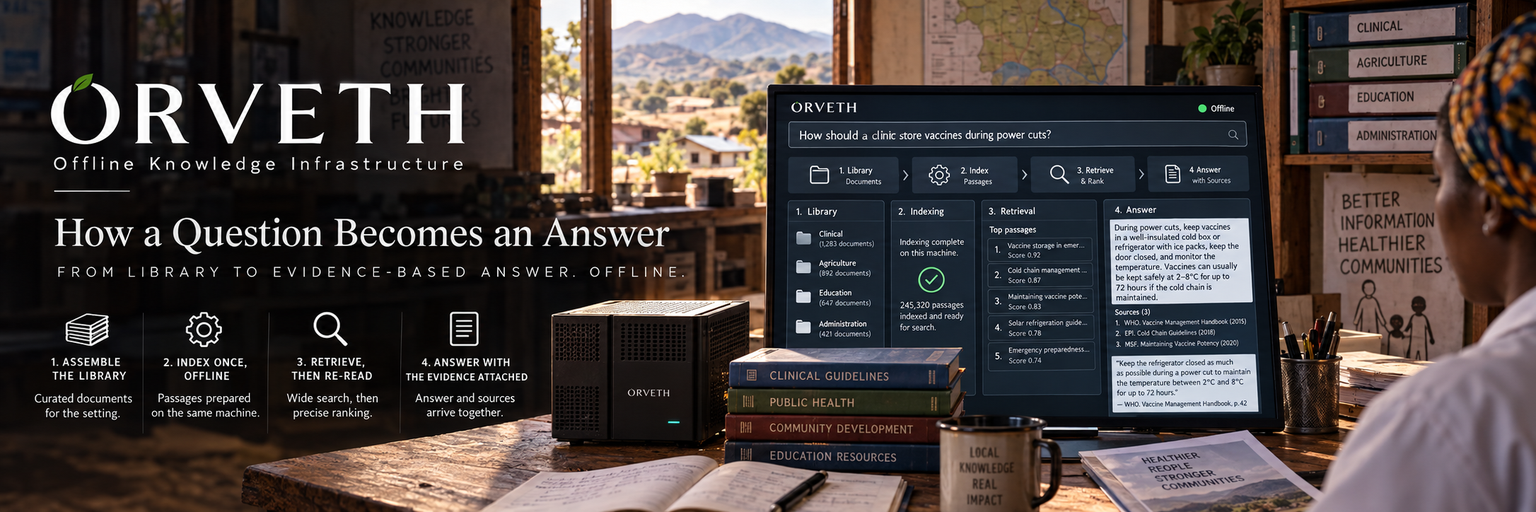
The collection is chosen deliberately for the setting — clinical, educational, agricultural, administrative — and each document is recorded with what it is, where it came from and when it was issued.
Documents are split into passages and indexed in a single pass that can run overnight on the same machine, so bringing in a new body of material is an evening's work rather than a project.
A question pulls a wide set of candidate passages from the index, and the ranking pass narrows them to the few that genuinely bear on it.
The model writes its answer from those passages and returns them alongside it, so the answer and the reason to believe it arrive together.
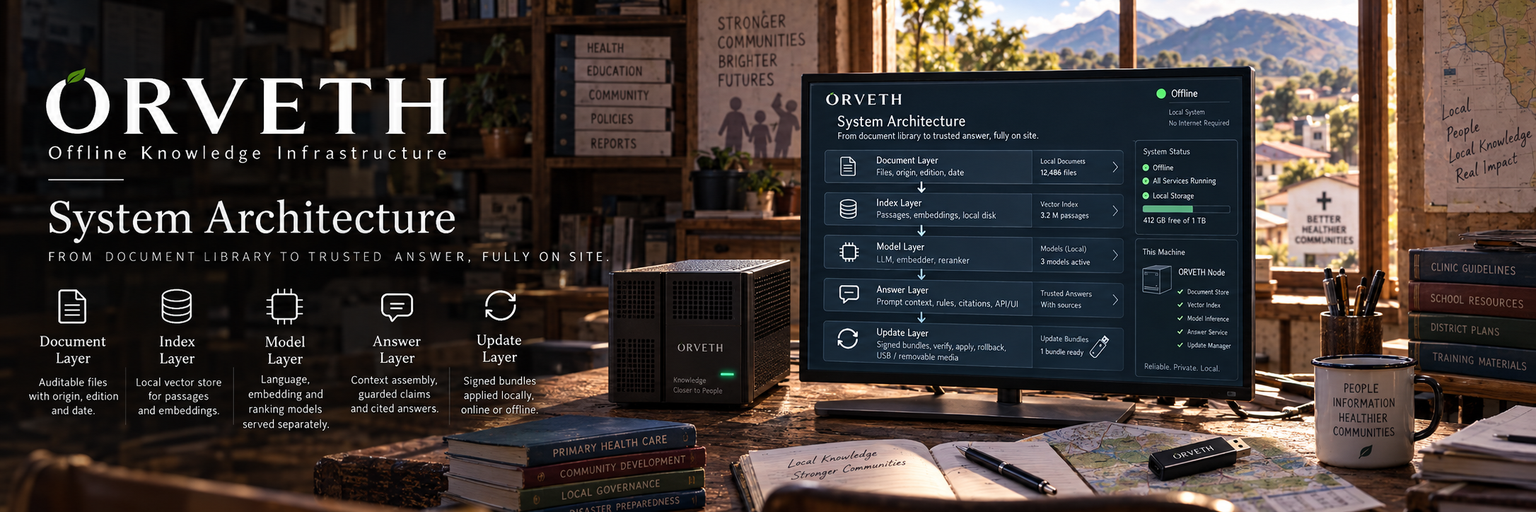
The library itself, held as files with their own record of origin, edition and date, so that a collection can be audited, corrected and handed to another site intact.
A vector store holding the passages and their embeddings on local disk, sized so that a full rebuild is possible on the same machine that serves the questions.
Serving for the language model, the embedding model and the ranking model, kept apart from the library so a better model can replace an older one without rebuilding the collection.
The part that assembles context, applies the limits on what may be claimed, and returns the answer with its citations to whatever interface the site is using.
Collections travel as signed bundles on removable media as readily as over a network, and a site can verify, apply and roll back an update without help from anyone outside.
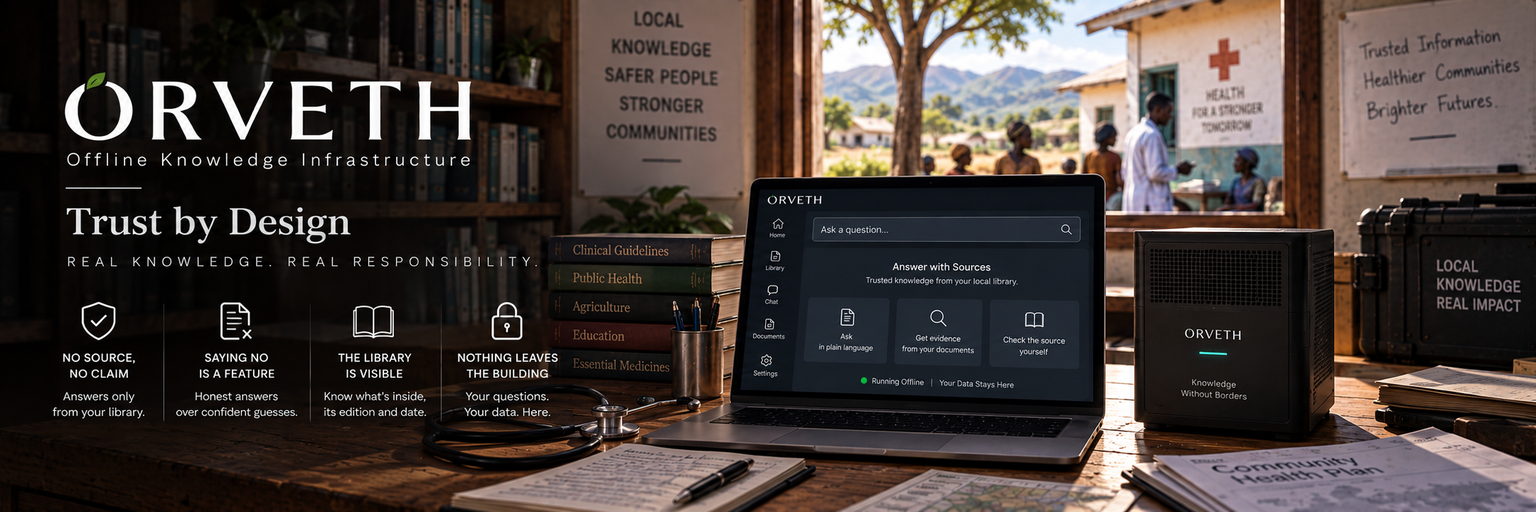
The system answers from the library in front of it. Where the passages do not support an answer, the honest output is that the library does not cover it — not a fluent guess.
Refusing to answer is treated as correct behaviour and measured as such, because in a clinic or a classroom a confident wrong answer costs more than no answer at all.
Anyone can see what is in the collection, what edition it is and when it was added, which makes the limits of the system legible instead of mysterious.
Questions, documents and answers stay on the local machine by default. Where a site chooses to sync, it chooses what goes and can read the record of what went.
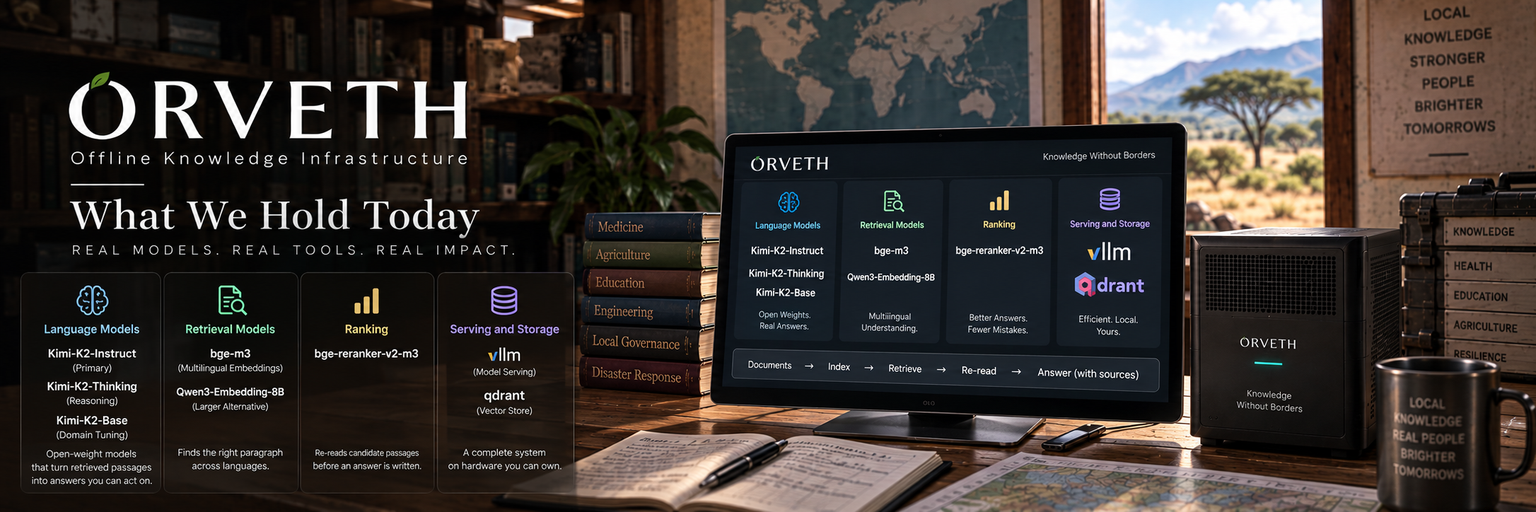
Kimi-K2-Instruct as the primary open-weight model, with Kimi-K2-Thinking for questions that need a longer chain of reasoning and Kimi-K2-Base where we tune for a specific collection — the part of ORVETH that turns retrieved passages into an answer a person can act on.
bge-m3 for multilingual passage embeddings and Qwen3-Embedding-8B as the larger alternative where the hardware allows it — together, the reason a question finds the right paragraph in a collection written in another language.
bge-reranker-v2-m3 re-reads the candidate passages against the question before anything is written, which is the single step that most reduces confident answers drawn from the wrong page.
vllm to run the models efficiently on one accelerator and qdrant to hold the passage index on local disk — the two pieces that make a full question-and-answer system fit on a machine a site can own outright.
ZAFUNDI SAFARI teaches where connectivity is thin and OBUNETU builds the networks that reach those same places. ORVETH is what keeps working in the hours when the link does not.
Schools and training centres, district health services, government offices working from paper regulation, and development organisations that need the same reference material at twenty sites at once.
We have not published accuracy or latency figures from our own bench, and we have not yet assembled the reference collections themselves — choosing and clearing that material is a body of work in its own right, and this page does not pretend it is finished.
A first collection built with a partner who knows the subject, measured runs on the hardware a site would actually buy, and an update path that a person with a box of drives and no connection can carry out alone.
"Knowledge is not what is stored somewhere. It is what can be reached from where you stand."
ORVETH — Offline Knowledge Infrastructure.