"A picture that moves used to need a crew, a location and a week. The idea was never the expensive part — the shooting was."
Most of what a company wants to show the world never gets filmed. The budget covers one shoot a year, and every other idea stays a sentence in a document that nobody outside the room ever sees.
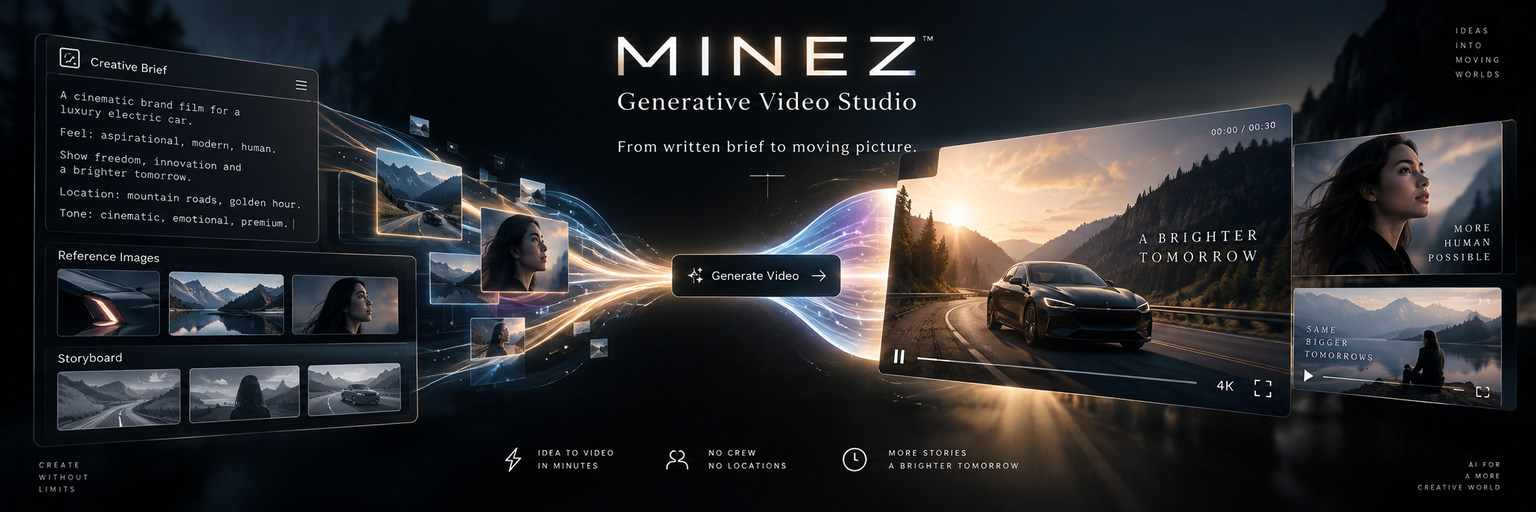
MINEZ turns a written brief and a handful of reference stills into finished moving pictures — for a product, a campaign or a story that would otherwise never have been shot at all.
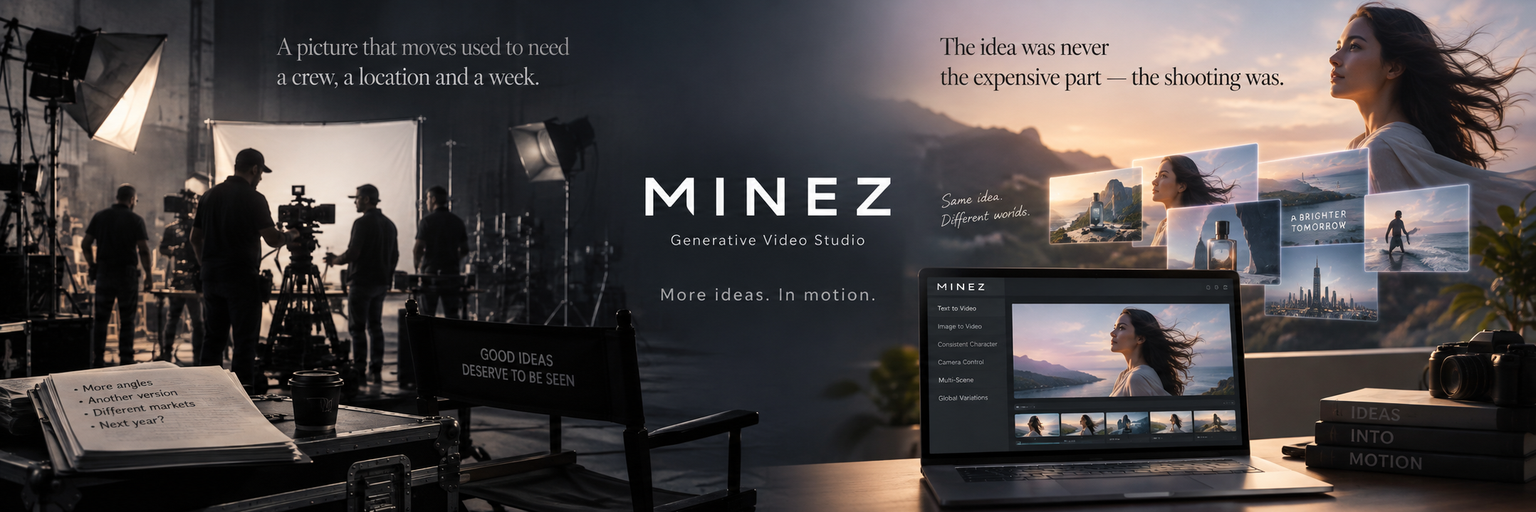
Crew, location, equipment and a day of everybody's time cost roughly the same whether the result runs for thirty seconds or thirty minutes. That floor is what keeps small ideas from ever being made.
Once the crew has gone home, a change of script, language or aspect ratio means shooting again. So the first cut becomes the only cut, and the work stops improving the day it is delivered.
The same product sells differently in different places, but reshooting for each one is out of reach. What ships instead is one film for everybody, fitting nobody particularly well.
Plenty of tools produce a striking few seconds and nothing you can actually cut with — no consistent character, no control over the camera, no way to hold a look across a sequence.
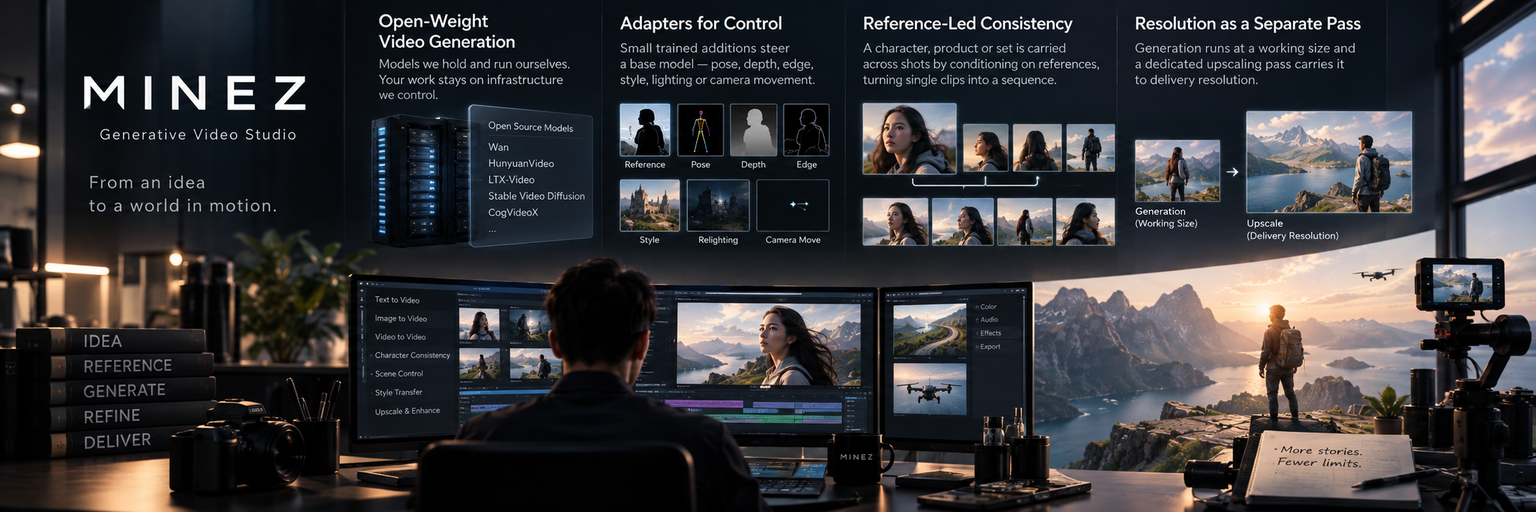
Models whose weights we hold and run ourselves, rather than an outside service we send a client's unreleased product to. What we generate stays on infrastructure we control.
Small trained additions steer a base model without retraining it — holding a pose, following a depth or edge reference, colouring a plate, relighting a scene or moving the camera in a named way.
A character, a product or a set is carried across shots by conditioning on references rather than by hoping the model remembers, which is what turns single clips into a sequence.
Generation runs at a working size and a dedicated upscaling pass carries it to delivery resolution, so a change of idea costs a cheap render rather than an expensive one.
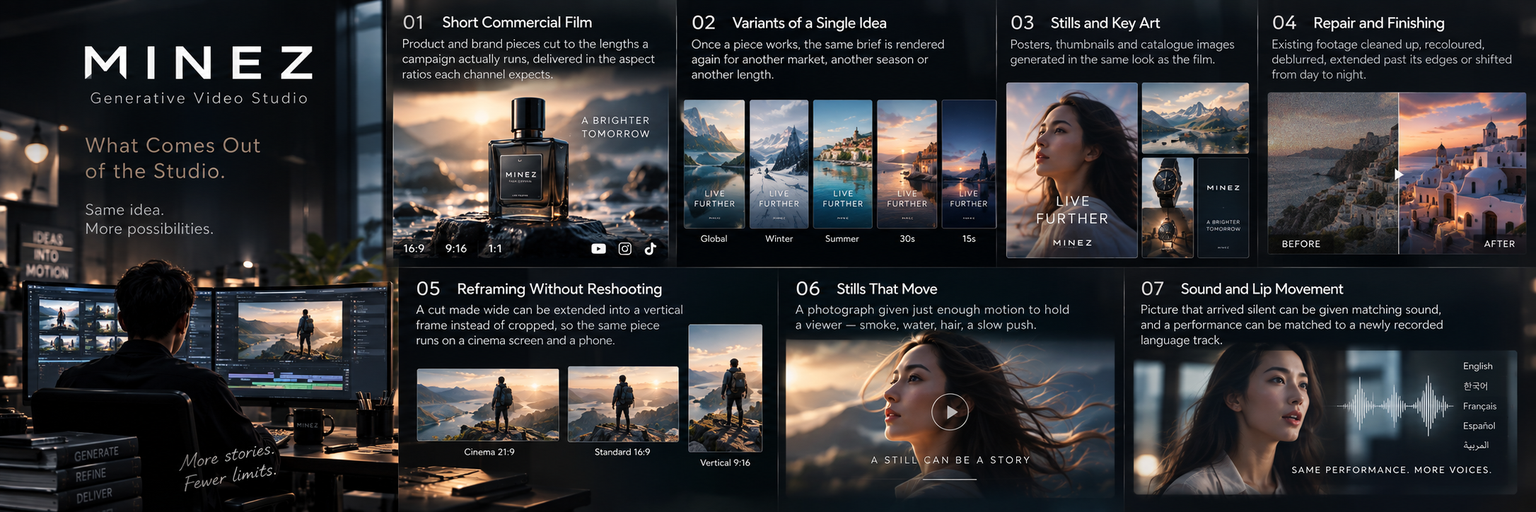
Product and brand pieces cut to the lengths a campaign actually runs, delivered in the aspect ratios each channel expects rather than one master cropped badly for all of them.
Once a piece works, the same brief is rendered again for another market, another season or another length — the expensive thinking happens only once.
Posters, thumbnails and catalogue images generated in the same look as the film, so a campaign holds together instead of looking assembled from two different sources.
Existing footage cleaned up, recoloured, deblurred, extended past its edges or shifted from day to night — useful even when nothing new is generated at all.
A cut made wide can be extended upward and downward into a vertical frame instead of cropped into one, so the same piece runs on a cinema screen and a phone without losing half its composition.
A photograph given just enough motion to hold a viewer — smoke, water, hair, a slow push — for storefronts, title cards and listings where a full film would be too much.
Picture that arrived silent can be given matching sound, and a performance can be matched to a newly recorded language track, which is where this studio hands off to MELVIS and takes the result back.
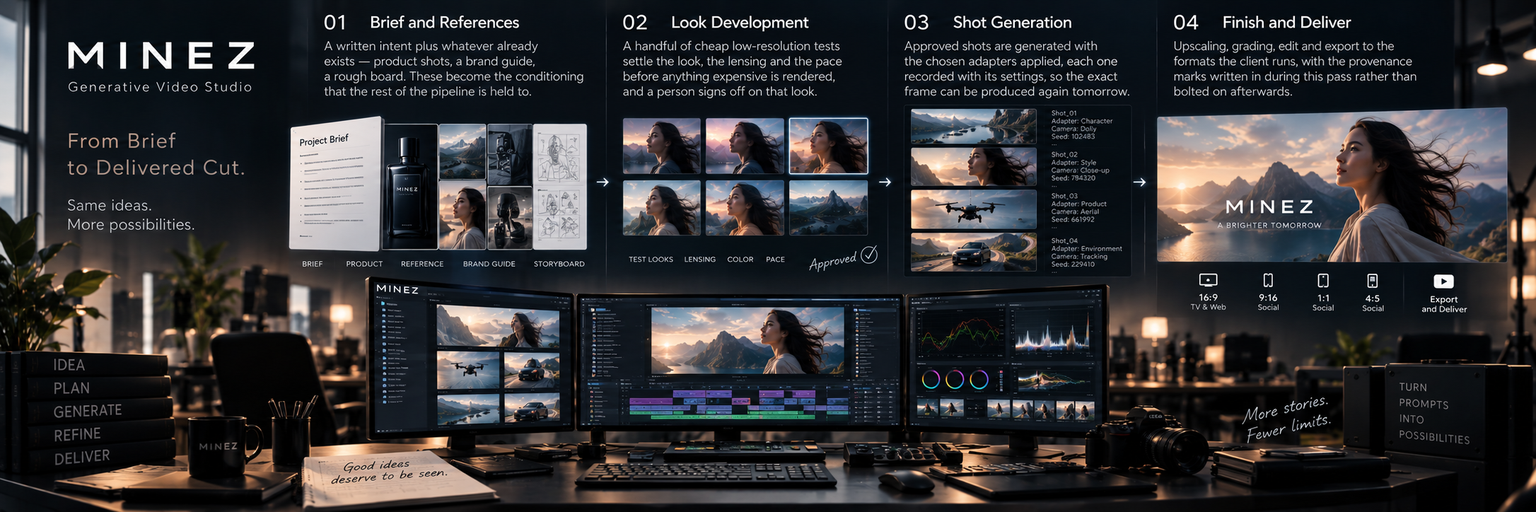
A written intent plus whatever already exists — product shots, a brand guide, a rough board. These become the conditioning that the rest of the pipeline is held to.
A handful of cheap low-resolution tests settle the look, the lensing and the pace before anything expensive is rendered, and a person signs off on that look.
Approved shots are generated with the chosen adapters applied, each one recorded with its settings, so the exact frame can be produced again tomorrow.
Upscaling, grading, edit and export to the formats the client runs, with the provenance marks written in during this pass rather than bolted on afterwards.
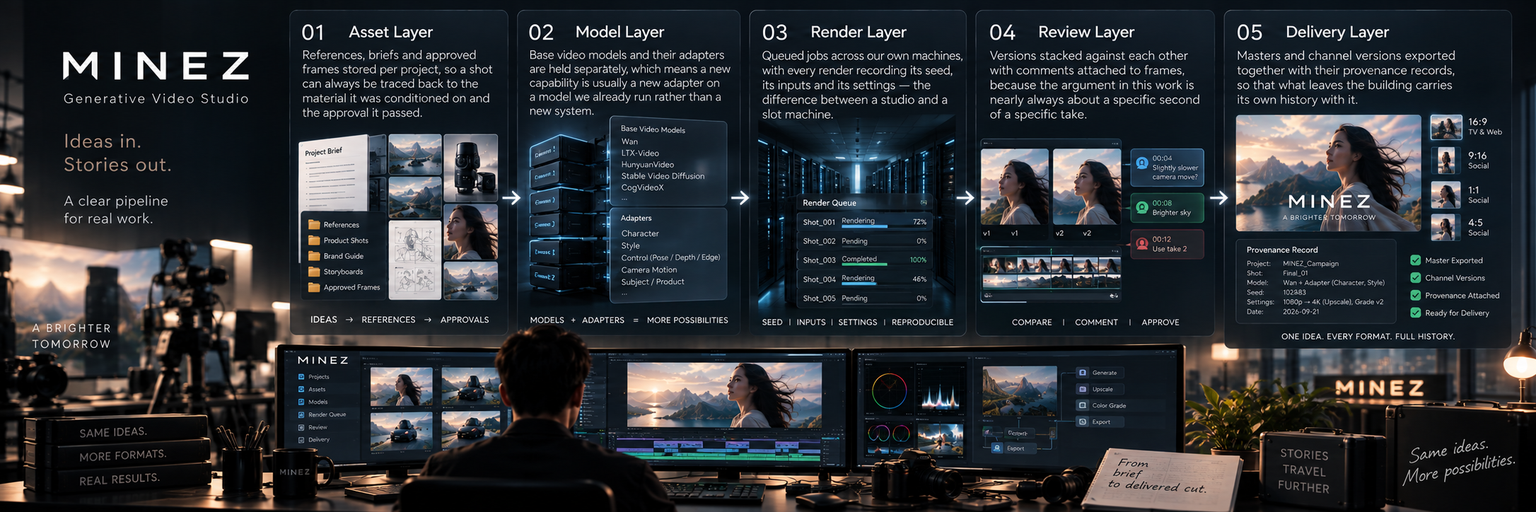
References, briefs and approved frames stored per project, so a shot can always be traced back to the material it was conditioned on and the approval it passed.
Base video models and their adapters are held separately, which means a new capability is usually a new adapter on a model we already run rather than a new system.
Queued jobs across our own machines, with every render recording its seed, its inputs and its settings — the difference between a studio and a slot machine.
Versions stacked against each other with comments attached to frames, because the argument in this work is nearly always about a specific second of a specific take.
Masters and channel versions exported together with their provenance records, so that what leaves the building carries its own history with it.
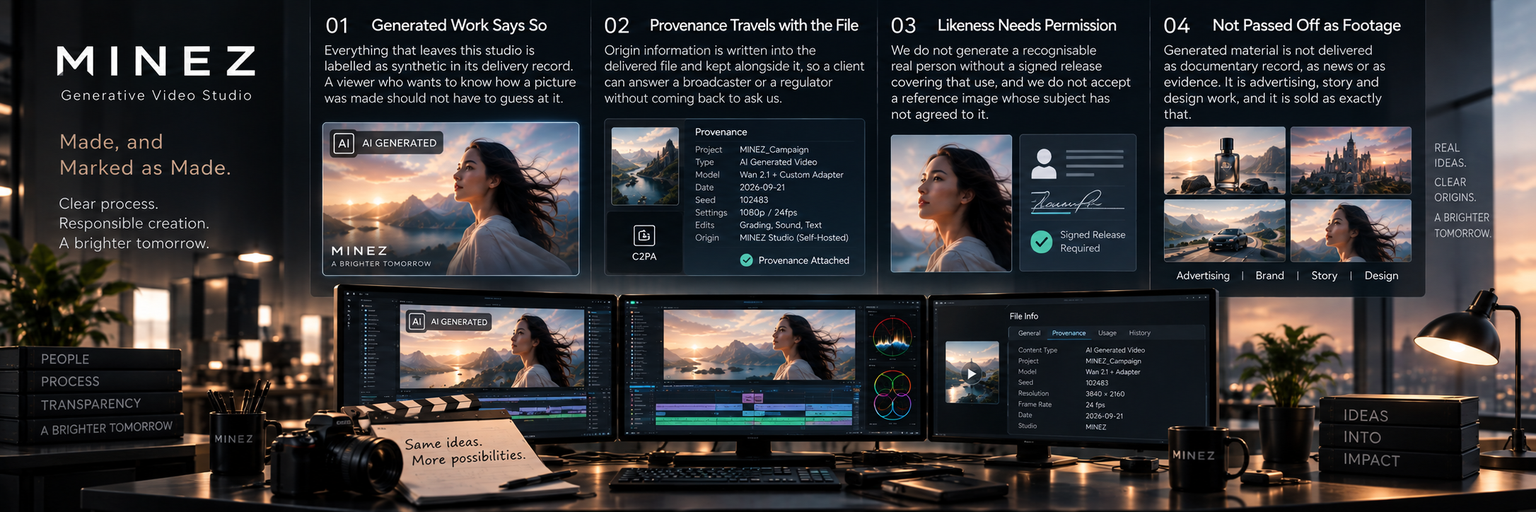
Everything that leaves this studio is labelled as synthetic in its delivery record. A viewer who wants to know how a picture was made should not have to guess at it.
Origin information is written into the delivered file and kept alongside it, so a client can answer a broadcaster or a regulator without coming back to ask us.
We do not generate a recognisable real person without a signed release covering that use, and we do not accept a reference image whose subject has not agreed to it.
Generated material is not delivered as documentary record, as news or as evidence. It is advertising, story and design work, and it is sold as exactly that.
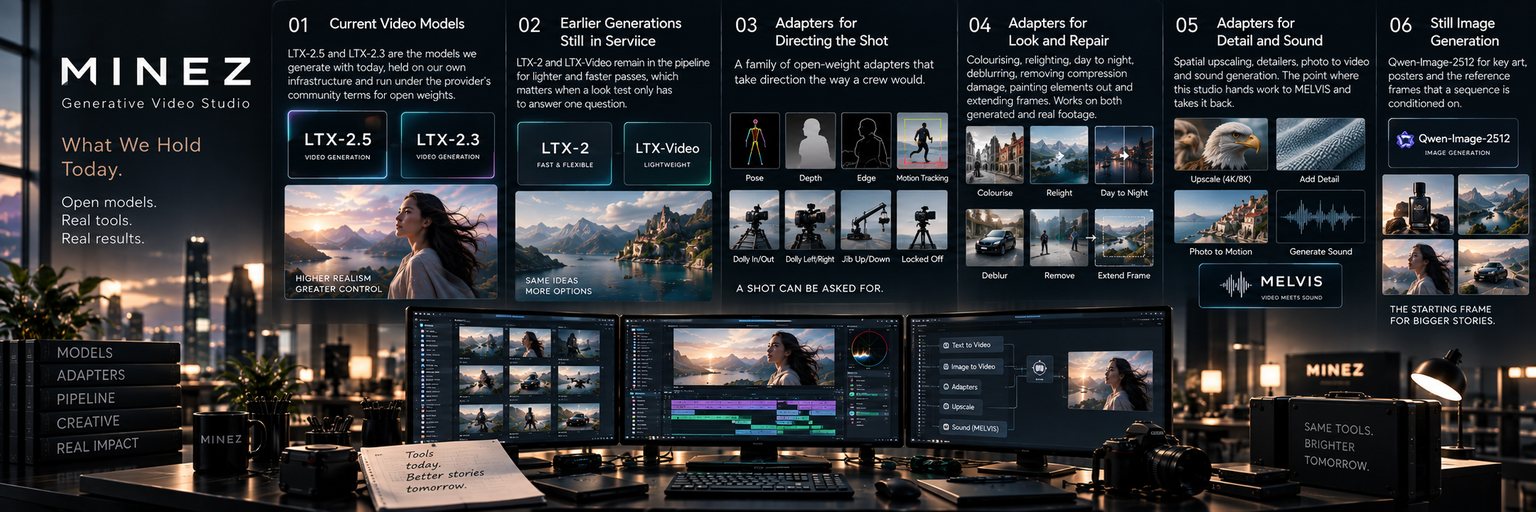
LTX-2.5 and LTX-2.3 are the models we generate with today, held on our own infrastructure and run under the provider's community terms for open weights.
LTX-2 and LTX-Video remain in the pipeline for lighter and faster passes, which matters when a look test only has to answer one question.
A family of open-weight adapters that take direction the way a crew would: pose, depth and edge references to hold a subject where it belongs, motion tracking to follow something across the frame, and named camera moves — dolly in and out, dolly left and right, jib up and down, or locked off — so a shot can be asked for rather than hoped for.
The same family covers what a finishing house does: colourising, relighting, turning day into night, deblurring, removing compression damage, painting elements out to a clean plate and extending a frame past its original edges. Much of this works on footage that was shot normally, with nothing generated at all.
Spatial upscaling carries a cheap working render to delivery resolution as a separate pass, detailers add fine texture, one adapter brings a still photograph into gentle motion, and another generates sound to match a picture that arrived silent — the point where this studio hands work to MELVIS and takes it back.
Qwen-Image-2512 for key art, posters and the reference frames that a sequence is conditioned on before any motion is generated at all.
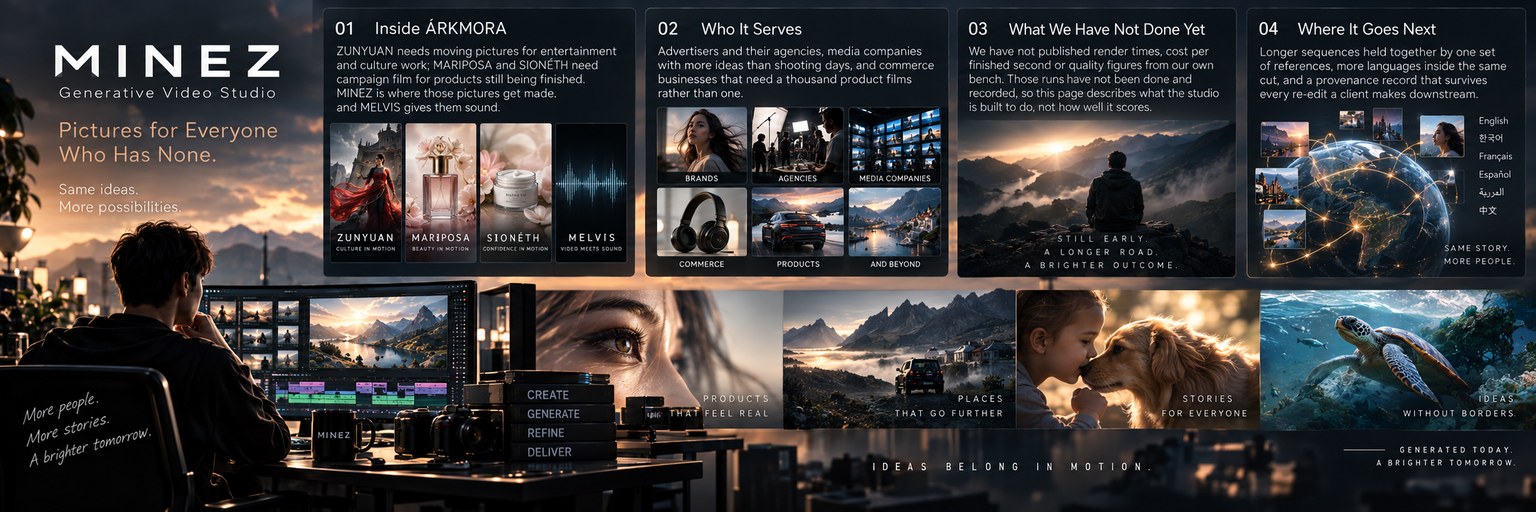
ZUNYUAN needs moving pictures for entertainment and culture work; MARIPOSA and SIONÉTH need campaign film for products still being finished. MINEZ is where those pictures get made, and MELVIS gives them sound.
Advertisers and their agencies, media companies with more ideas than shooting days, and commerce businesses that need a thousand product films rather than one.
We have not published render times, cost per finished second or quality figures from our own bench. Those runs have not been done and recorded, so this page describes what the studio is built to do, not how well it scores.
Longer sequences held together by one set of references, more languages inside the same cut, and a provenance record that survives every re-edit a client makes downstream.
"The idea was never the expensive part. We took the rest of the cost out of the way."
MINEZ — Generative Video Studio.